

Handwriting
Intent
At St Cuthbert Mayne Catholic Primary School, our intent is for every child to develop a fluent, legible and efficient handwriting style that enables them to communicate their ideas confidently and effectively.
We recognise that fluent handwriting supports children to become successful writers because, as handwriting becomes increasingly automatic, children are able to devote greater attention to the content and composition of their writing. This reflects the principles of Read Write Inc. Handwriting, which aims to build children’s confidence and fluency as writers through direct teaching and regular practice.
From the earliest stages, we aim to develop secure foundations, including comfortable pencil control and accurate letter formation. Children then progress towards accurate placement, joining and, ultimately, a fluent and confident handwriting style.
We want all children to take pride in their handwriting and presentation and to see themselves as successful writers.
Implementation
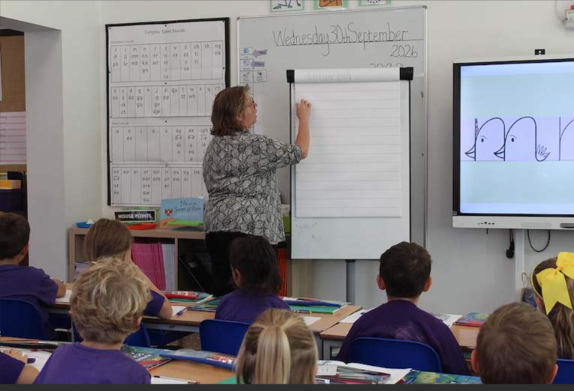
Handwriting is taught explicitly and progressively, using the principles and approach of Read Write Inc. Handwriting.
-
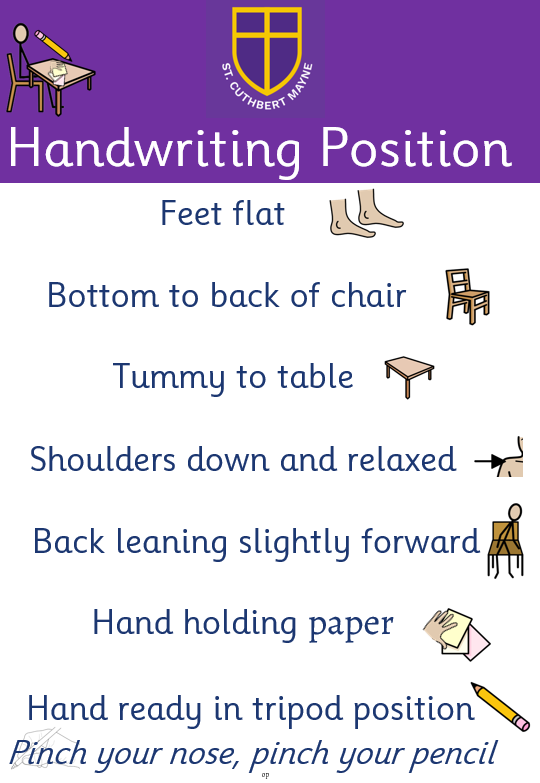
In Reception, handwriting is closely linked to Read Write Inc. Phonics. Children are taught how to hold a pencil comfortably and form letters correctly, using familiar Read Write Inc. mnemonics to support accurate formation.
-
Children receive direct teaching and regular opportunities to practise handwriting, enabling them to establish good habits from the beginning. Read Write Inc. specifically advocates short, daily handwriting teaching and practice.
-
Children initially develop accurate letter formation, before learning how letters are positioned appropriately on the line.
-
As children become secure in forming individual letters, teaching develops towards a handwriting style that can flow naturally into joined writing. Children subsequently learn how letters are joined before building greater fluency.
-
The memorable visual cues and mnemonics within the programme support children in remembering how letters and joins are formed, rather than relying simply on copying.
-
Teachers model handwriting clearly and consistently and reinforce high expectations for handwriting and presentation across the curriculum.
-
As children progress through Key Stage 2, the emphasis increasingly moves towards fluency, consistency, stamina and speed, while maintaining legibility.
-
Children who find handwriting more difficult are identified and provided with additional modelling, practice and appropriate support to enable them to make progress.
Impact
Through our systematic approach to handwriting, we aim for children to become confident, fluent and independent writers.
By the time children leave St Cuthbert Mayne, we expect them to:
- form letters accurately and consistently;
- position and size letters appropriately;
- join letters correctly and confidently where appropriate;
- develop a fluent, legible and increasingly automatic handwriting style;
- write with sufficient speed and stamina to meet the demands of the curriculum;
- maintain high standards of presentation across different subjects;
- take pride in their written work;
- apply handwriting skills consistently and independently; and
- concentrate increasingly on what they want to communicate, rather than the physical process of forming letters.
Ultimately, our aim is for handwriting to become an automatic and confident process, supporting children to express their knowledge, creativity and ideas successfully across the curriculum.
Our progression in a nutshell
Pencil control → Correct letter formation → Positioning and sizing → Joining → Fluency → Stamina and automaticity