

History
Intent
At St Cuthbert Mayne Catholic Primary School, we believe that history helps children to understand who they are, where they come from, and how the past continues to shape the world around them. We want our pupils to see history as a process of enquiry, encouraging them to ask questions, investigate evidence and develop their own understanding of significant events, people and civilisations.
Our history curriculum inspires pupils to become curious, critical thinkers who can explore the past with confidence and purpose. Through the study of local, British and world history, children develop a secure understanding of chronology and gain an appreciation of how societies, cultures and communities have changed over time.
As a Catholic school, we encourage pupils to reflect on themes of justice, compassion, courage, resilience and human dignity. Through studying the successes, challenges and mistakes of the past, children develop empathy, learn to respect different perspectives and understand how individuals and communities can influence change.
Through the Kapow Primary History scheme, pupils develop knowledge of significant events and individuals, while building an understanding of key historical concepts, including:
- Power
- Invasion, settlement and migration
- Empire and civilisation
- Religion and belief
- Trade and achievement
- Society and culture
We aim for every child to develop the knowledge, vocabulary and skills needed to think and work as historians, preparing them for future learning and helping them become informed and responsible citizens.
Implementation
At St Cuthbert Mayne Catholic Primary School, history is taught through the Kapow Primary History scheme, which provides full coverage of the National Curriculum through carefully sequenced, knowledge-rich units.
In the Early Years Foundation Stage, children begin to develop an understanding of the past through the Understanding the World area of learning. In Key Stages 1 and 2, history is taught for one half-term each term, equating to approximately 18 hours of curriculum time annually.
The curriculum is built around five key strands:
- Topic Knowledge
- Chronological Awareness
- Historical Enquiry
- Disciplinary Concepts
- Substantive Concepts
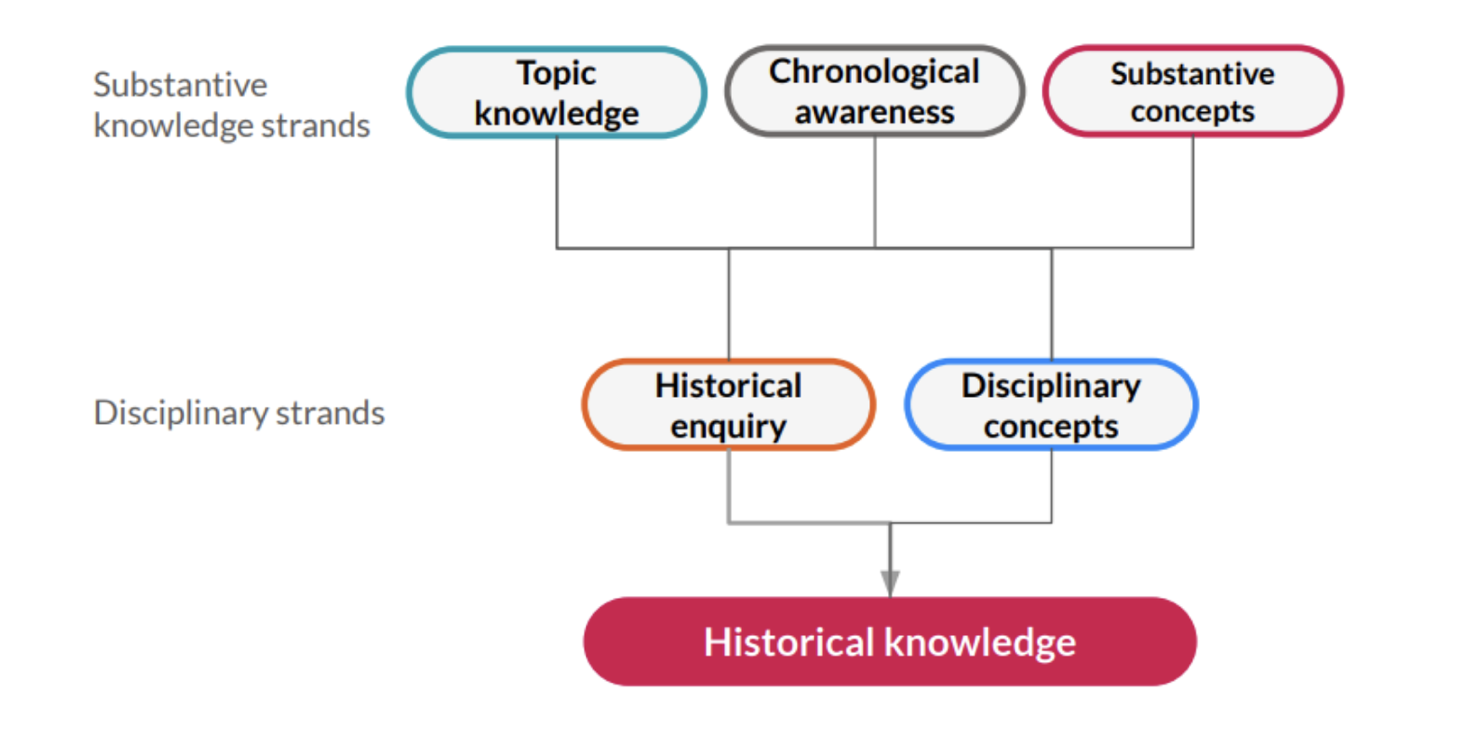
These strands are woven throughout every unit, ensuring that pupils gain historical knowledge while developing the skills historians use to investigate and interpret the past.
Learning is centred around enquiry questions that encourage pupils to ask meaningful questions, analyse sources, evaluate evidence and draw informed conclusions. A strong emphasis is placed on chronology, enabling children to make connections across different periods of history and build a secure understanding of historical timelines.
Throughout the curriculum, pupils explore key disciplinary concepts including:
- Change and continuity
- Cause and consequence
- Similarity and difference
- Historical significance
- Historical interpretations
- Sources of evidence
Lessons are varied, engaging and inclusive, combining discussion, research, source analysis, collaborative learning, drama and practical activities. Opportunities for educational visits, visitors and the use of artefacts further enrich learning and help bring history to life.
Teachers adapt lessons to meet the needs of all learners, ensuring appropriate challenge and support so that every pupil can succeed and make progress.
Impact
The impact of the history curriculum at St Cuthbert Mayne Catholic Primary School is seen in pupils who are knowledgeable, inquisitive and confident historians. They develop a secure understanding of chronology, make connections across periods of history and use evidence to support their ideas and conclusions.
Assessment is ongoing and includes retrieval practice, teacher questioning, lesson outcomes, end-of-unit quizzes and knowledge assessments. In Years 2 to 6, pupils complete a double-page spread at the end of each unit to showcase and consolidate their learning.
Subject leaders monitor the quality and impact of the curriculum through:
- Pupil voice
- Book studies
- Learning walks
- Lesson observations
- Assessment analysis
- Curriculum reviews
By the time pupils leave St Cuthbert Mayne Catholic Primary School, they will:
- Know and understand the history of Britain and its place within the wider world.
- Develop a secure understanding of chronology and historical change over time.
- Understand significant civilisations, societies and cultures from the past.
- Use historical vocabulary confidently and accurately.
- Ask and answer historically valid questions.
- Analyse and interpret a range of historical sources.
- Explain how and why historical interpretations differ.
- Construct informed arguments using evidence.
- Recognise the impact of significant individuals, events and achievements.
- Develop curiosity, empathy and a lifelong interest in history.
Through their historical studies, pupils leave St Cuthbert Mayne equipped with the knowledge, skills and understanding needed for future learning and for active participation in modern society.
Oracy
At St Cuthbert Mayne Catholic Primary School, history provides rich opportunities for pupils to develop their speaking and listening skills. Pupils are encouraged to:
- Discuss and interpret historical sources.
- Explain and justify conclusions using evidence.
- Present historical arguments and viewpoints.
- Question, challenge and evaluate the ideas of others respectfully.
- Participate in debates and discussions.
- Engage in role-play and drama activities, such as hot-seating and freeze-framing.
- Deliver presentations and share findings with different audiences.
- Use precise historical vocabulary when speaking.
These opportunities help children become confident communicators who can articulate their ideas clearly, listen thoughtfully to others and engage critically with the past.
Catholic Ethos
Our history curriculum supports our Catholic mission by helping pupils understand the dignity of every person and recognise the contributions, achievements and experiences of people throughout history.
The curriculum encourages pupils to:
- recognise the value and dignity of all people;
- develop empathy for individuals and communities from the past;
- understand how beliefs and values influence actions and decisions;
- appreciate diversity within societies and cultures;
- reflect on issues of justice, equality and human rights;
- learn from historical examples of courage, service and perseverance; and
- consider how they can contribute positively to society today.
Through studying history, pupils gain a deeper understanding of humanity and their role as responsible citizens within God's world.
British Values
The history curriculum promotes British Values through:
- Democracy by exploring how societies and political systems have changed over time and how citizens have contributed to decision-making.
- Rule of Law by examining how laws, rights and responsibilities have developed throughout history.
- Individual Liberty by studying individuals who have shaped history through their actions, beliefs and achievements.
- Mutual Respect by learning about a wide range of people, cultures and civilisations and valuing different perspectives.
- Tolerance of Those with Different Faiths and Beliefs by developing an understanding of diverse societies, traditions and worldviews from different periods of history.