

Geography

At St Cuthbert Mayne Catholic Primary School, we use the Kapow Primary Geography scheme to support and enrich the teaching of geography, ensuring a coherent, engaging and knowledge-rich curriculum that meets the requirements of the National Curriculum.
Intent
At St Cuthbert Mayne Catholic Primary School, our mission is to help every child flourish academically, spiritually, socially and emotionally. We believe that communication is central to successful learning, enabling pupils to articulate their understanding, share their ideas and apply their knowledge across a range of meaningful experiences.
Through our geography curriculum, St Cuthbert Mayne Catholic Primary School aims to inspire curiosity and wonder about the world, encouraging children to develop a lasting fascination with places, people and the environment. Geography helps pupils make sense of the world around them by developing their understanding of physical and human processes, diverse cultures and communities, and the interdependence of people and environments.
We seek to equip children with the knowledge, vocabulary and skills needed to become informed, responsible global citizens. Reflecting our Catholic ethos, we encourage pupils to recognise their role as stewards of God's creation and to understand the dignity of all people. Pupils are encouraged to explore contemporary issues, including climate change and sustainability, and to understand how their actions can contribute positively to their local community and the wider world.
Geography also provides opportunities for children to investigate their local area, building a strong sense of identity, belonging and appreciation for their community. The carefully sequenced curriculum develops knowledge and skills progressively, ensuring that learning is both relevant during primary education and provides a secure foundation for future study.
Implementation
In the Early Years Foundation Stage, geographical understanding is developed through Understanding the World. In Key Stages 1 and 2, geography is taught for one half-term each term, equating to approximately 18 hours per year.
The curriculum is structured around four key strands:
- Locational Knowledge
- Place Knowledge
- Human and Physical Geography
- Geographical Skills and Fieldwork
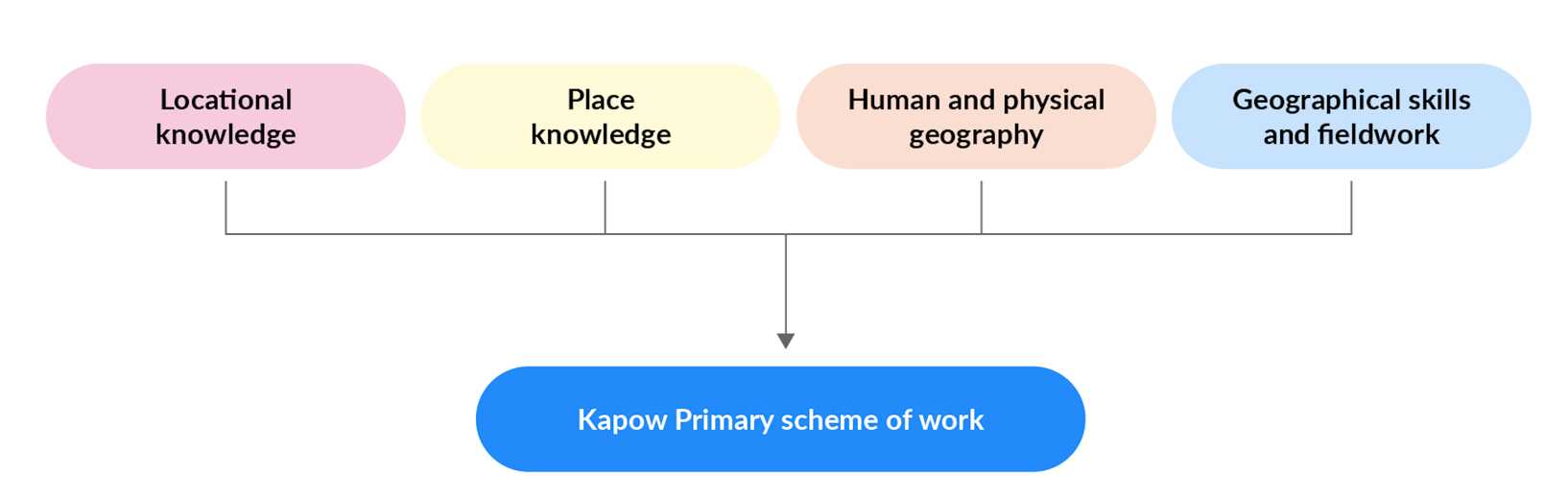
Kapow’s spiral curriculum ensures that knowledge and skills are revisited and built upon over time, enabling pupils to develop increasingly secure understanding and geographical expertise.
Learning is driven by enquiry-based questions that encourage pupils to investigate, analyse evidence, think critically and communicate their conclusions. Through these enquiries, children develop the ability to collect, interpret and present information using a range of geographical methods.
Fieldwork is embedded throughout the curriculum, with pupils regularly exploring the school grounds and local area to observe, measure, record and present findings. These experiences develop practical geographical skills while strengthening pupils' understanding of their locality and the wider world.
A range of teaching approaches, including discussion, collaborative learning, practical investigations and technology-enhanced activities, ensure lessons are engaging and accessible to all learners.
Whilst Kapow provides a comprehensive framework, teachers adapt learning to meet the needs of their pupils, ensuring appropriate challenge, support and opportunities for success for all.
Impact
The geography curriculum at St Cuthbert Mayne Catholic Primary School equips pupils with the knowledge, skills and understanding needed to become confident geographers and active citizens. Through high-quality teaching and meaningful enquiry, pupils develop a coherent understanding of the world and the relationships between people, places and environments.
By the time pupils leave St Cuthbert Mayne Catholic Primary School, they will:
- Have a secure understanding of diverse places and environments around the world.
- Understand the relationship between human and physical geography.
- Use and apply a broad range of geographical vocabulary accurately.
- Demonstrate confidence in geographical enquiry and fieldwork.
- Collect, interpret and present geographical information effectively.
- Analyse evidence and draw reasoned conclusions.
- Show curiosity about the world and its people.
- Understand environmental issues and sustainability at local, national and global levels.
- Recognise their responsibility as stewards of God's creation and understand how they can contribute positively to their community and the wider world.
Oracy
Geography provides rich opportunities for pupils to develop their speaking and listening skills. Pupils are encouraged to:
- discuss geographical issues and environmental challenges;
- explain observations and findings from fieldwork;
- present research and geographical enquiries;
- debate local, national and global issues;
- justify opinions using geographical evidence;
- ask and answer questions about places and environments;
- work collaboratively to solve geographical problems; and
- use precise geographical vocabulary when speaking.
These opportunities help children become confident communicators who can articulate their ideas clearly, listen respectfully to others and engage thoughtfully with the world around them.
Catholic Ethos
As a Catholic school, we encourage pupils to be good stewards of creation. Geography helps children develop respect for different people, cultures and environments while fostering a sense of responsibility for the world God has entrusted to us. We want all pupils to become knowledgeable, compassionate and environmentally aware citizens who understand the importance of sustainability and caring for others.
At St Cuthbert Mayne Catholic Primary School, climate change education is woven throughout our geography curriculum and linked closely to the Catholic life and ethos of the school. Through a range of units, case studies and fieldwork opportunities, pupils explore environmental issues at local, national and global scales.
Children learn about the causes and impacts of climate change, investigate environmental challenges within their local area and explore practical ways in which individuals and communities can work towards a more sustainable future. In line with Catholic Social Teaching and the call to care for our common home, we aim to empower pupils to become environmentally aware and responsible citizens.
Our goal is to help children develop the knowledge and confidence to make informed choices, understand the impact of human actions on the environment and contribute thoughtfully to conversations about the future of our planet.
British Values
- Democracy: Exploring how communities make decisions about land use, sustainability, resources and environmental issues, while considering how people can work together to improve places and environments.
- Rule of Law: Understanding the responsibilities of individuals, communities and governments in protecting environments, managing resources and responding to geographical challenges.
- Individual Liberty: Developing the confidence to form and express views about geographical issues, such as sustainability, climate change and environmental responsibility, whilst respecting the opinions of others.
- Mutual Respect: Learning about diverse places, cultures and communities around the world, fostering respect for people whose lives, beliefs and experiences may differ from their own.
- Tolerance of Those with Different Faiths and Beliefs: Exploring how people live in different environments and communities, helping children develop an understanding of and appreciation for different cultures, traditions and ways of life across the globe.